



Great business school brand campaigns
The campaigns that broke the sector’s sea of sameness – a working reference, updated for 2026.
Line up the websites of some of the world’s top business schools, prise the names off, and you’d be forgiven for struggling to tell one from another. It was a version of the problem Wharton identified when the school set out to rebrand in 2012: an inconsistent, insufficiently distinctive identity in a highly competitive sector. The same aspirational stock photography, the same promises of transformation, the same words. A sea of, well, sameness. But that’s not true in every case.
Below is a working reference to eight of the best business school brand campaigns – from Kellogg’s Think Bravely to INSEAD’s Force for Good – and the strategy behind what made each one work.
As a quick note: these are brand, positioning or community campaigns, not enrolment-funnel advertising – the work that decided what a school stands for, not just how it fills places. Listed in no particular order.
Knowledge for Action – The Wharton School, developed by Wharton with creative execution by Karma, 2012
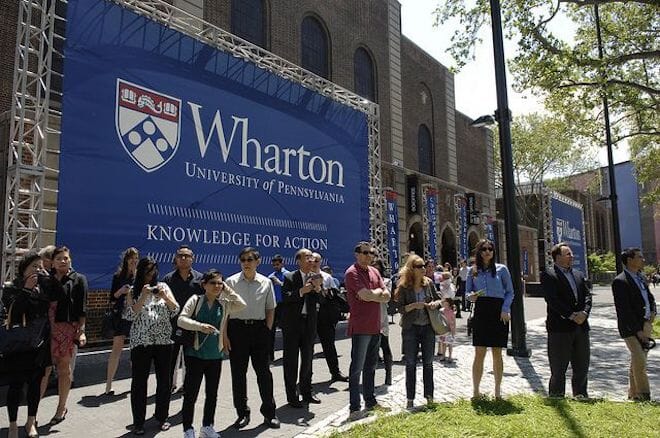
The idea: A flexible “Knowledge for…” platform – Action, Global Impact, Innovation, Life – unified under one message and a signature identity, sharpened through a crowdsourced “innovation tournament” that consulted thousands of faculty, students and alumni.
Why it worked: The process embodied the brand. Wharton turned its own tools – rigorous analysis and an innovation tournament – on itself, so the way the brand was built became proof of what the school actually does. The identity gave a large, centre-heavy institution one recognisable, ownable look.
The result: Knowledge for Action remains Wharton’s guiding motto and ‘Knowledge’ defines much of the marketing department’s activity to this day. An impressive linguistic achievement, given shifting market pressures and priorities.
Takeaway: when the way you build a brand embodies the brand itself, the process becomes the proof.
Widen Your World – Alba Graduate Business School, by SIM7, 2024
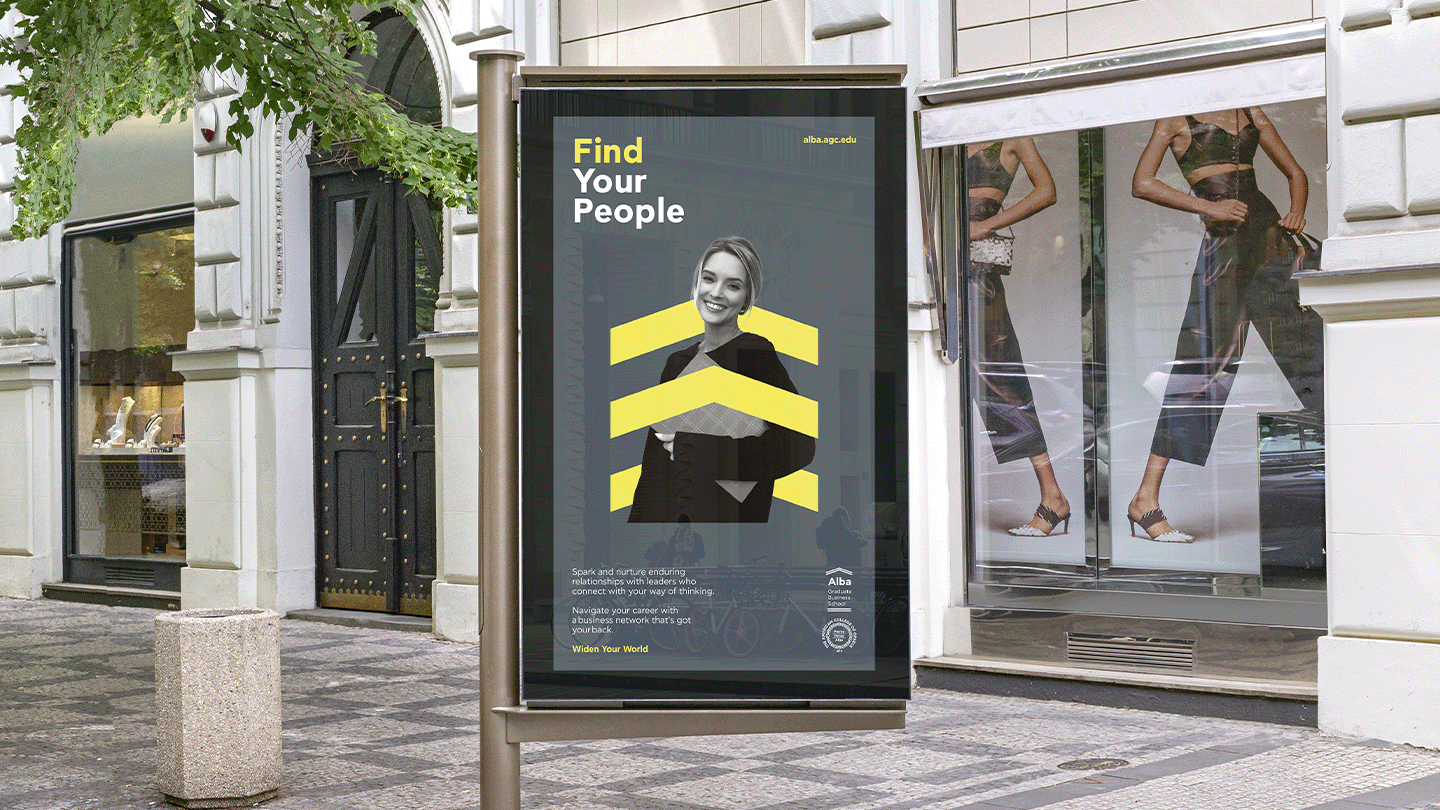
The idea: A brand campaign built on a single organising line – “Widen your world” – expressing the conviction that for today’s leaders, knowledge alone is no longer enough; they need global dialogue, relationships, insight and agility. Four pillars carry this campaign: go beyond borders, find your people, sharpen your understanding, embrace agility.
Why it worked: It turned what could read as a small school’s limitation – Alba was founded out of a specific national need in Greece – into its exact promise: a route to widen a leader’s world through international perspective and connection. The bold chevron visual system and a “business unusual” tone gave it cut-through across out-of-home, print and social.
The result: According to Alba, Widen Your World has become one of its most successful brand campaigns, supporting admissions in both international and domestic markets. The campaign remains live and is expected to be renewed.
Takeaway: the sharpest positioning turns a school’s constraint into its promise.
See how we developed Alba’s Widen Your World campaign, from strategy to execution.
Explore the Widen Your World case study →
Think Bravely – Kellogg School of Management, developed in-house, 2011

The idea: A full repositioning of Northwestern’s Kellogg under a new dean, built on the belief that business can be bravely led, passionately collaborative and world-changing.
Why it worked: It committed to a point of view at a moment when the school was ready to change more than its marketing – the brand line was the visible edge of a genuine strategic reset, not a lick of paint.
The result: A landmark of business school repositioning, widely covered in the trade press; it was replaced by “Inspiring Growth” in 2014 as the strategy matured.
Takeaway: a brand line only holds if the institution behind it is actually changing.
Real Leadership – IESE Business School, by SIM7, 2024
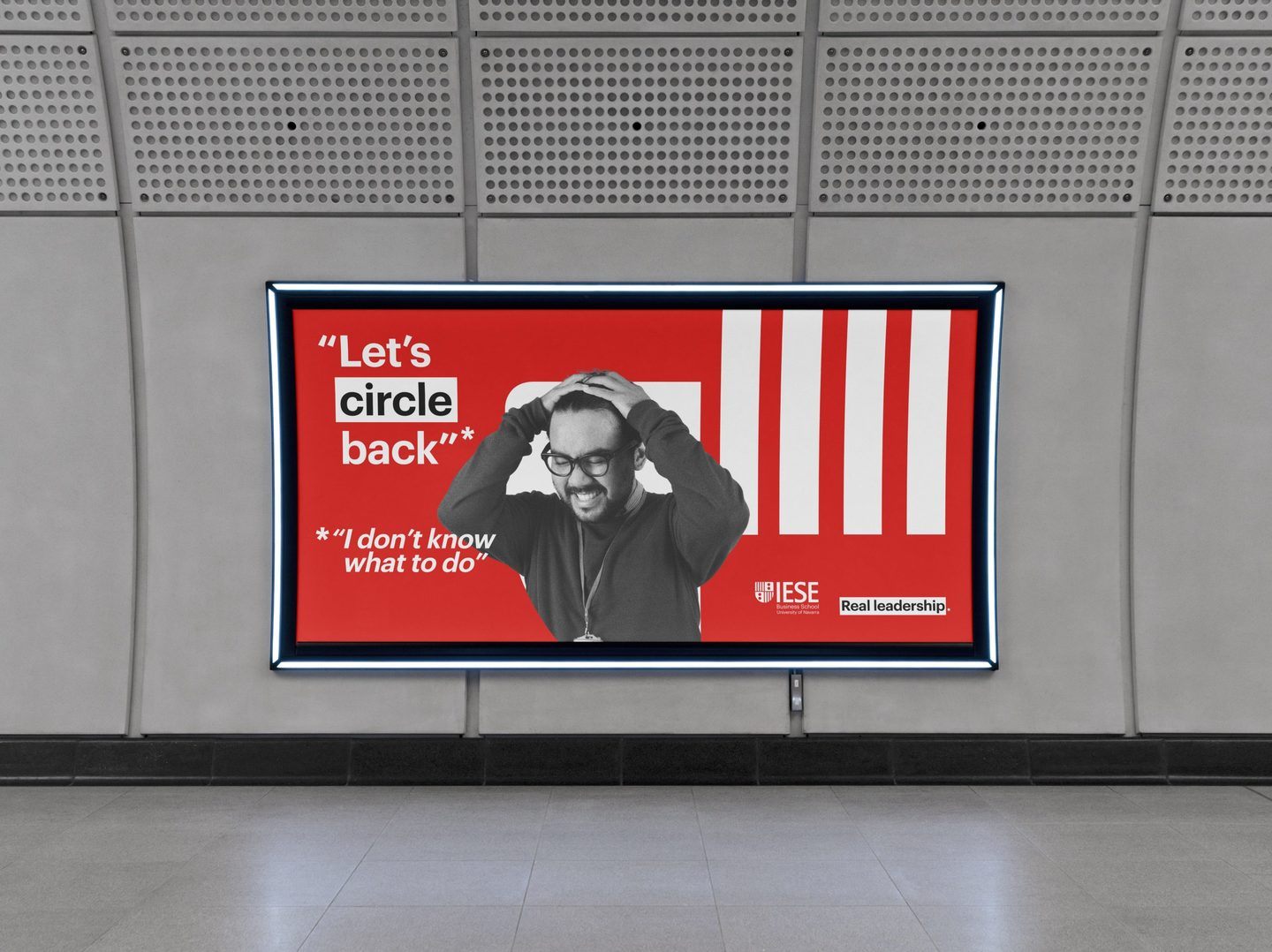
The idea: An honest, human campaign built as an antidote to the clichéd “business speak” that dominates executive education marketing – spanning out-of-home across Europe and Latin America, a podcast and campaign film.
Why it worked: It ignored the category’s default register of aspirational corporate gloss and tapped the genuine anxieties and motivations of senior leaders, cutting through to an audience often numb to the sector’s marketing claims.
The result: Won a Búho for Brand Strategy at Educafestival, first place in Brand Campaign at the Digital Communication Awards, and a CMI Content Marketing Award – ahead of entries from Ketchum, MSLGROUP and Weber Shandwick.
Takeaway: in a sea of sameness, authenticity is the differentiator.
See how we built IESE’s Real Leadership campaign – the strategy, the work, and the results in full. Explore the Real Leadership case study →
At the Very Center of Business – Columbia Business School, in-house (Marketing & Communications), 2013
The idea: A positioning campaign that made Columbia’s New York City location the entire argument – “at the very center of business” – anchored by a two-minute film, “The Center,” and four pillars: knowledge, access, community and impact. It replaced the school’s unofficial “Theory to Practice” line.
Why it worked: It turned a fixed asset no rival could copy – being in the heart of New York – into the brand’s core proof. Location became the differentiator, and because the line came straight out of stakeholder research, it read as recognition of something true rather than a smart invention.
The result: Durable: this is still Columbia’s positioning line more than a decade after its 2013 launch.
Takeaway: your most defensible brand asset is often the thing competitors physically cannot replicate.
Now What? – Salford Business School, by Creative Concern, 2020

The idea: A recruitment campaign built on provocative one-line headlines – “Now what?”, “Who cares?”, “Why stay?” – each opening into an explanatory copy line, and led by a proposition no rival offered: every applicant gets an offer of a place, conditional on grades.
Why it worked: It reset creative conventions. Students were photographed with the professional sheen of a business-magazine profile rather than a university brochure, and the headlines had the confidence to ask a blunt question rather than make a claim – art direction and copy together making a challenger school feel like the assured choice.
The result: The campaign ran across digital and out-of-home, with an in-house toolkit for the Salford team. Specific enrolment metrics for the campaign have not been published – 2020/2021 intake was challenging for obvious reasons.
Takeaway: borrowing the codes of a more credible category – here, editorial – can lift how a school is read.
Force for Good – INSEAD, by Perfect Day, 2013–2023

The idea: A decade-long capital campaign built on a single conviction – that business can be a force for good – with its visual identity and language crafted by Perfect Day, mobilising INSEAD’s global alumni network behind scholarships, sustainability and research.
Why it worked: It gave a fundraising ask an idea worth belonging to. Rather than asking alumni to give to a school, it asked them to join a belief about what business is for – turning a transactional appeal into a statement of identity.
The result: Launched in 2013 and closed in 2023, the campaign raised over €310 million against an initial €200 million target, with 52% of alumni and students taking part.
Takeaway: a campaign raises more when it sells a conviction, not a cause.
Real Impact – IMD, by Cavalcade, 2025
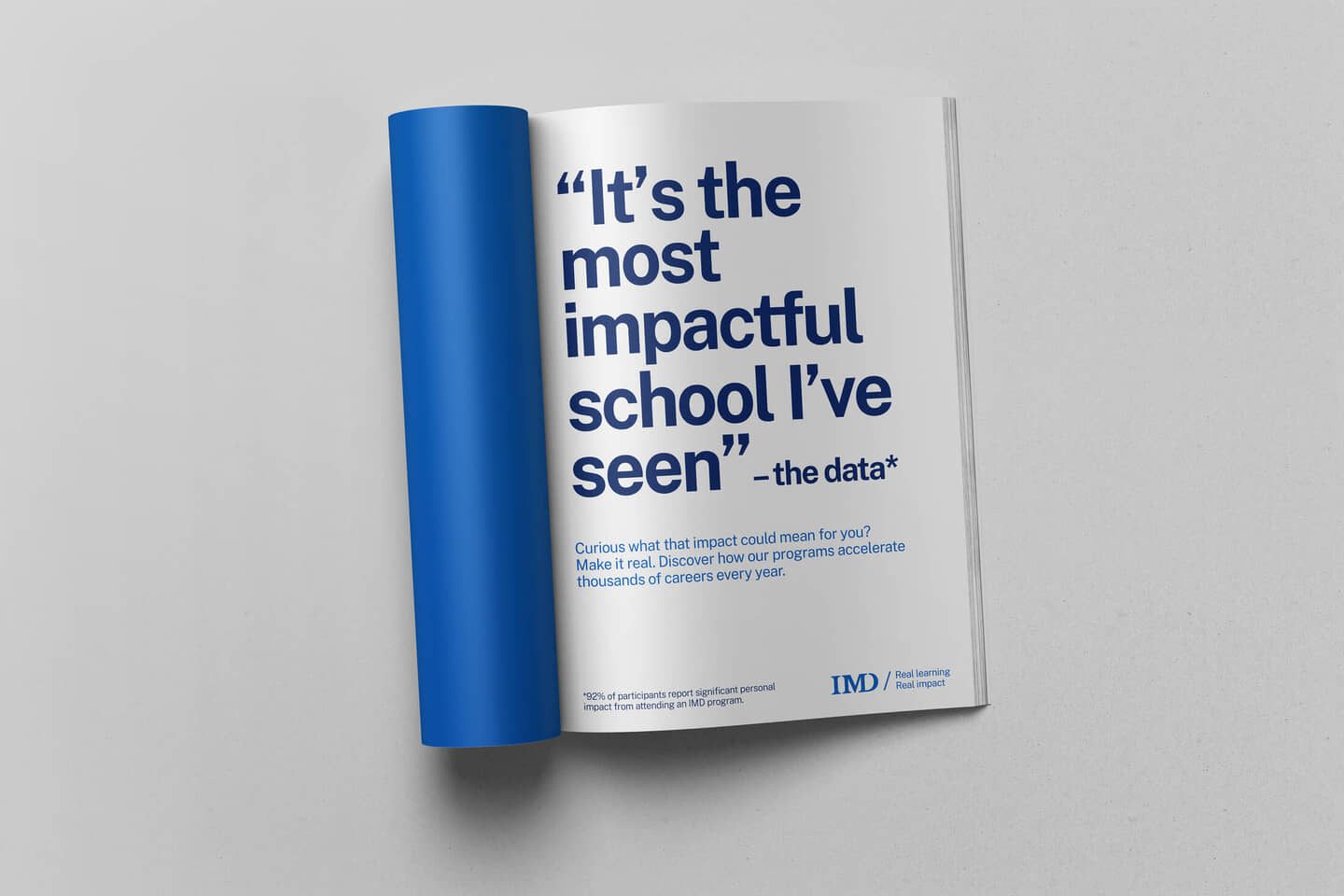
The idea: A strategy and ad platform that sharpened IMD’s credo – “real learning, real impact” – into a single ambition: to become the world’s most impactful business school, with a promise of learning grounded in the executive’s own reality.
Why it worked: It took the one word every school reaches for – impact – and made it the whole strategy rather than a smart claim. Do IMD now ‘own’ impact? The jury is out.
The result: The campaign launched in 2025, so meaningful performance results have not yet been published.
Takeaway: “impact” is an empty word until you make it measurable – you own it by proving it, not saying it.
What the best have in common
None of these campaigns won through marketing power alone. They won through creativity and by being specific – naming a truth about the school that no competitor could honestly borrow, before committing to it in language that sounded like nobody else in the category.
In a sector where most brands are interchangeable, difference is the whole strategy.
SIM7 builds brand and messaging for business schools around the world. If your school sounds like everyone else, that’s something we can help with.
FAQs: business school brand campaigns
What makes a business school brand campaign work?
The best business school brand campaigns work by naming a specific truth about the school that no competitor could honestly claim, then committing to it in language that sounds like nobody else in the category. Kellogg’s Think Bravely worked because a real strategic reset sat behind the line; Columbia’s At the Very Center of Business worked because its New York location was a fixed asset rivals couldn’t copy. Difference, not volume, is the strategy.
What are some examples of great business school brand campaigns?
Standout examples include Kellogg’s Think Bravely, Wharton’s Knowledge for Action, Columbia’s At the Very Center of Business, INSEAD’s Force for Good fundraising campaign, IMD’s Real Impact platform, and SIM7’s Real Leadership for IESE and Widen Your World for Alba Graduate Business School. Each took a different route – repositioning, location, philanthropy, or challenger positioning — but all replaced generic aspiration with something specific and ownable.
Why do business schools all sound the same?
Most business schools market themselves with the same aspirational imagery, the same promises of transformation and the same vocabulary – so much so that Wharton, setting out to rebrand in 2012, found it hard to tell the top schools apart once the names were removed. This “sea of sameness” is the sector’s default condition, and it’s precisely why a distinctive brand campaign is such a competitive advantage.
What’s the difference between a business school brand campaign and enrolment marketing?
Enrolment marketing is designed to fill places – lead generation, admissions funnels, performance advertising. A brand campaign decides what the school stands for: its positioning, its story, and the single idea that sets it apart. The strongest brand campaigns make the enrolment work easier by giving prospective students a reason to care before they ever reach an application form.
Does a great business school brand campaign need an agency?
Not always. Columbia’s At the Very Center of Business was developed in-house by its marketing team, straight out of stakeholder research. But agencies bring an outside eye that’s often essential for spotting the ownable truth a school is too close to see – the difference between a campaign that names something real and one that settles for a catchy phrase.